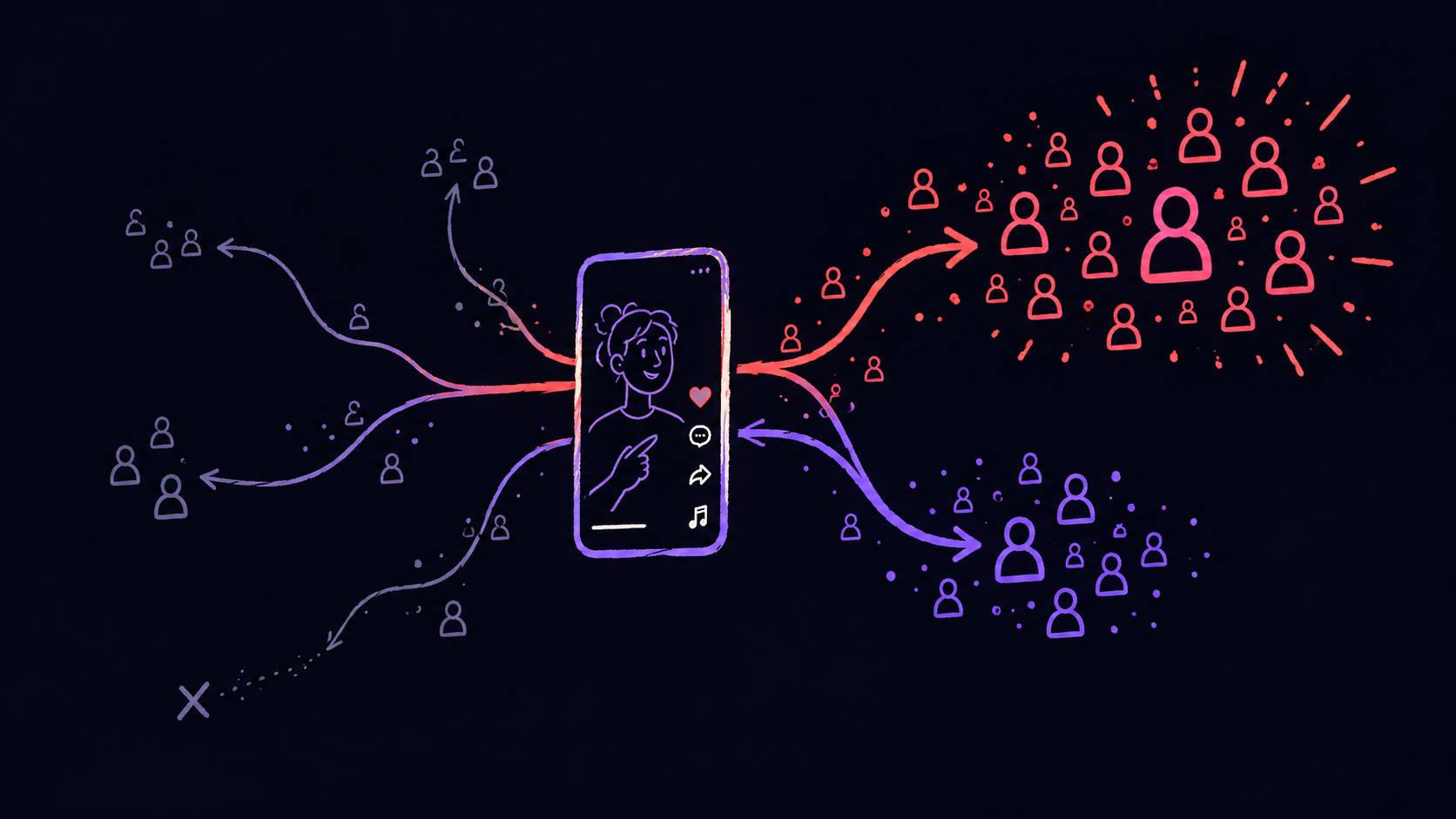




Canvas UGC is a content marketing model where creators publish recurring short-form videos through social media accounts built specifically to promote one product or brand. Instead of relying on an influencer's existing following, these accounts start from zero and use organic distribution to reach potential users.
For consumer apps, Canvas UGC offers a unique opportunity. You can test different ways of presenting your product, see which ideas resonate with people, and use what you learn to improve the next round of content, all while earning organic distribution.
Done properly, Canvas UGC becomes an ongoing operation for creative testing and distribution. The same process that gives your app opportunities to reach new users organically can also help you develop creative concepts worth testing in paid acquisition.
But there’s quite a bit of work behind making that happen.
This guide covers what Canvas UGC really means, how this model works, what separates a good program from a collection of creators posting videos, and how to evaluate whether this model is worth the investment for you.
What Does Canvas UGC Mean
Canvas UGC describes an account and distribution model where creators set up (or are given) a social account built specifically around a single product or brand. It isn't the creator's personal page, nor is it the brand's official handle. It exists purely so the creator can repeatedly publish short-form content about the product, in a way that feels native to the platform and is discovered organically.
Imagine you run a productivity app. Instead of paying an influencer to feature it on their personal TikTok or Instagram account, you recruit several creators to run new pages dedicated to your product.
One creator might build a page around productivity tips for students. Another could focus on workplace organisation; a third creates content around the frustrations of managing a busy schedule. A fourth could purely run relatable skits and funny videos around the problems your app solves.
Each creator produces short-form content that aligns with their persona and makes sense for their audience, and they regularly introduce the app through relatable pain points, demonstrations, or use cases.
Each page starts without an inherited following. Whether the content reaches people depends on its ability to earn organic distribution through platforms such as TikTok and Instagram.
That's where the name comes from. The account is effectively a blank canvas.
What makes a program Canvas UGC
The core Canvas UGC model has a few defining characteristics:
- Purpose-built accounts: Creators publish through brand new pages that are established around a specific product or brand, rather than relying on their personal profiles.
- Creator-native content: Videos are made by creators who understand the intended audience and the short-form formats those viewers already consume.
- Organic distribution: Content is initially published through dedicated pages, with reach earned through platform distribution rather than purchased through an influencer's existing audience.
- Recurring publishing: Creators produce and publish content regularly, giving the program continuing opportunities to reach viewers and test creative approaches.
A good Canvas UGC program also has a deliberate process for learning from the content being published and iterating based on that.
This is where execution can make or break a Canvas UGC campaign.
You can hire ten creators, have them post every day, and end up with hundreds of videos without learning much about what your audience wants to see.
Canvas UGC is most impactful when someone is analysing which messages work, why certain creators perform better, and how those findings should influence the next round of content.
Iteration isn't necessarily part of every provider's definition of Canvas UGC. But without it, you're leaving much of the model's potential unused.
Other details can also vary considerably between different Canvas UGC programs and providers. Some campaigns may run with five creators; others could have dozens. Creator compensation might be fixed, performance-based, or a combination. Accounts can belong to the brand or the agency, depending on the arrangement.
All of the above are implementation choices. But the underlying publishing and distribution model remains broadly the same.
Canvas UGC vs. Traditional UGC, Influencer Marketing, and Tech UGC
You'll see several different terms used for creator marketing, and the differences might not always be obvious.
The easiest place to start is by looking at what you're paying for and how the content gets distributed.
Canvas UGC vs. Traditional UGC vs. Influencer Marketing
With traditional or packaged UGC, you usually pay a creator to produce a video, then receive the finished asset. Your team decides whether to use it in paid advertising, on your own social channels, or elsewhere, subject to the agreed usage rights.
With influencer marketing, the main part of what you're buying is access to the creator's existing audience. Their followers, reputation, and relationship with that audience are all part of the value.
Canvas UGC works differently. Here, creators regularly publish content through purpose-built pages, and organic distribution is part of the program itself.
Model | Traditional UGC | Influencer Marketing | Canvas UGC
What you're buying | Creative assets | Content and temporary access to an existing audience | Recurring creator content and organic distribution
Where it's published | Wherever the brand chooses | Creator's established account | Purpose-built pages dedicated to the product
Requires an existing following | No | Yes, usually part of the value | No
Ongoing publishing | Not inherently | Depends on the agreement | Yes, core to the model
Creative testing | Depends on how the brand uses the assets | Depends on the arrangement | A major opportunity within the model
None of these is universally the better choice.
- Traditional UGC is best when you mainly need creative for paid ads and don't need to prove concepts organically first.
- Influencer marketing works when you want to rent a spike in attention or borrow credibility in a niche, and you're willing to pay for reach rather than build it.
- Canvas UGC suits brands that want a scalable system for creator-led content, test different ways of presenting your product, and give that content opportunities to earn organic reach. Winners can then be boosted with paid spend, because they've already proven they resonate.
We cover the differences in more detail in our guide to UGC vs. Influencer Marketing.
Is Canvas UGC the Same as Tech UGC, High-Volume UGC, or Managed UGC?
Sometimes providers use these terms interchangeably. Other times, they're describing different aspects of a program.
Here's our preferred way of separating them:
Term | What it primarily describes
Canvas UGC | The dedicated account and organic distribution model
Tech UGC | Creator content for technology products, including apps, AI tools, SaaS products, and consumer-facing software
High-Volume UGC | The amount of content produced and the capacity for recurring creative testing
Managed UGC | The extent to which an external partner handles the operation
A consumer AI app could hire an agency to run ten dedicated creator accounts, producing hundreds of videos each month.
That program could reasonably be described as Canvas UGC, Tech UGC, High-Volume UGC, and Managed UGC.
The labels overlap because they're describing different characteristics of the same arrangement.
Not every provider draws these lines the same way. Some use Canvas, Tech, and High-Volume UGC as near-synonyms for the same offer. Some agencies include performance-based creator compensation in their definition of Canvas UGC, while others use Tech UGC as the umbrella term for a similar service.
That's why the name alone shouldn't determine what you buy. You need to understand where content gets published, what work is included, who controls the assets, and how the program is managed.
How Does a Canvas UGC Campaign Work?
A Canvas UGC program involves more than just recruiting creators and asking them to post videos.
The useful work starts before the first video goes live and continues as the program learns which approaches resonate.
Here's how the process typically works.
1. Define the Audience and Creative Strategy
Before choosing creators, you need to understand who you're trying to reach and why those people might care about your app.
Let’s go back to the example of a productivity app.
You could create content about its features: gamified tasks, time tracking, reminders, scheduling.
But those features aren't necessarily what makes someone stop scrolling.
- A university student might be more interested in avoiding last-minute deadline panic.
- A professional might care about finishing work earlier.
- Someone managing multiple projects might simply want a way to organise everything while feeling less overwhelmed.
Each of those is a different angle, and each could lead to several video concepts.
The starting strategy should identify which audience problems, product benefits, and creative approaches you want to explore.
You also need to decide what success means for the program. A company testing a pre-launch product proposition has a different objective from an established subscription app trying to find better acquisition creative.
Those priorities should influence the content from the beginning.
2. Recruit Creators and Set Up Dedicated Pages
With Canvas UGC, follower count should not be the main reason you hire a creator.
You're looking for people who can understand the audience and communicate the product naturally. They should also know how to make content people actually want to watch.
For a study app, someone who understands university life might be better suited to the campaign than a general lifestyle influencer with a much larger following.
Once creators are selected, they set up pages built around the product and its intended audience.
That means completing the profiles properly, developing a relevant persona or content identity, understanding the conversations happening in the niche, and engaging with those communities naturally.
You can't expect a new page to establish a useful presence by creating a blank profile and immediately flooding it with repetitive posts.
Creators should use the pages as genuine members of the communities they're trying to reach. They should engage with relevant content and contribute to discussions where it makes sense.
The important thing is establishing a credible page, engaging with relevant content, and producing content that earns the attention of the people you're trying to reach.
3. Develop the Content and Testing Plan
Once the creators understand the product and their audience, you need to decide what each round of content should explore.
There are several variables that should be tested:
- Angles: Which problem, use case, or benefit are you communicating?
- Hooks: How does the video introduce that idea and earn the viewer's attention?
- Formats: Does the concept work better as a product demonstration, a talking-head video, a skit, or a screen recording?
- Creators: Does the same idea resonate differently when presented by different people?
Let’s say you're promoting a study app that turns lecture recordings into flashcards and quizzes.
One creator could focus mostly on demonstrating the app through “reaction-to-demo” content.
Another might run talking-head content, opening with relatable stories about falling behind on lectures.
A third creator could produce skits about common university situations
A fourth could show the difference between manually organising notes and using the product.
Each approach might communicate a similar benefit, but they give the team different ways to evaluate what gets attention and generates product interest.
NOTE: You don't need to change every variable simultaneously. In fact, doing so makes the results much harder to interpret.
The goal is to design enough useful variation that the next creative decisions can be based on more than guesswork.
We go deeper on how to set up the experiments themselves in our guide to How to Test Canvas UGC for Your App.
4. Publish Consistently and Review Performance
Content is then produced and published through the dedicated creator pages.
Because these pages start without an inherited audience, their reach depends entirely on how people respond to the content and how the platform recommends it.
TikTok, for instance, considers signals including watch behaviour, interactions, and information about individual videos when recommending content.
That means a creator with very few followers can reach people who have never encountered the account before.
It also means individual results can vary drastically.
One video might barely get distributed. Another could reach hundreds of thousands of viewers. Two creators testing a similar idea might see very different results.
That's why you need enough content and meaningful creative variation to start recognising patterns rather than drawing conclusions from isolated posts.
Consistent publishing provides more opportunities to observe those patterns, but frequency alone won't make weak creative perform.
5. Use the Data to Improve the Next Round
Once content starts going live, the next round should reflect what you've learned.
Suppose your productivity app discovers that videos about missed deadlines regularly attract more relevant comments than general productivity advice.
That gives you a direction worth exploring.
You could then test different deadline scenarios, open with stronger visual hooks, change when the app appears in the video, or have other creators approach the same idea in their own style.
If a concept consistently attracts views but little product interest, you might need to improve how the app connects to the story.
If the audience doesn't seem relevant, you may need to reconsider the message itself.
Sometimes the issue is the hook. Sometimes it's the creator, format, audience, or the product's appeal. Organic data won't always tell you exactly which variable caused the result, but it can help you make more informed decisions about what to try next.
That feedback loop is one of the most valuable parts of a properly run Canvas UGC system.
Why Does High Volume Matter in Canvas UGC
You'll typically hear Canvas UGC discussed in terms of hundreds of videos.
There's a reason for that, but the value doesn't come from the number alone.
Volume gives you more room to test different creative approaches, gather audience feedback, and build on the concepts that show promise.
Compare two campaigns that each produce 300 videos.
Campaign A creates 300 videos using almost the same format, message, and opening hook.
Campaign B produces 300 videos across several audience problems, creative formats, hooks, and creators. Each round is informed by what the previous content revealed.
Both campaigns delivered the same number of videos.
But Campaign B explored a much wider range of possibilities. It has more opportunities to identify which ideas work for different audiences and which patterns might be worth repeating.
Volume becomes even more important once the program starts finding successful concepts.
Imagine you're producing 150 videos and discover that one approach performs significantly better than the others.
You now want to explore that concept more aggressively. But if most of your production capacity goes toward variations of that winner, you have less room to continue testing new ideas.
With 300 videos, you have more flexibility to iterate on what already shows promise while still dedicating meaningful production to discovering the next opportunity.
That's one of the biggest advantages of higher-volume campaigns. You can double down on successful formats without slowing down the rest of your experimentation.
How much volume do you actually need?
There's no magic number that guarantees you'll find a winning format.
The right scope depends on your product, creative hypotheses, number of creators, budget, and how much variation you're trying to explore.
At Plutus, our pilot campaigns start at 150 videos. That can be a useful starting point for testing Canvas UGC, but it's closer to a pilot-like scope and comes with limitations.
We also offer larger programs, from 300 original videos or more depending on the campaign, giving you more room to explore creative ideas and keep testing while scaling promising approaches.
It's also worth distinguishing unique videos from total publications. A campaign producing 150 original videos and distributing them across several platforms might generate a much higher total post count. Those additional posts can extend distribution, but they aren't the same as producing new creative concepts.
The question is how much useful testing capacity you're building and what you do with it.
The Two Phases of a Canvas UGC Program
One of the biggest mistakes brands make with Canvas UGC is judging every stage of a program using the same metrics.
A campaign that's still trying to discover what gets the attention of the right audience has a different job from one that's already identified promising formats and is trying to scale them.
It helps to think of the process in two broad phases.
Phase 1: Finding Content-Market Fit
The first phase is about discovering which creative approaches consistently resonate with the people you're trying to reach.
You may have a good product, a clear target audience, and an established marketing team, but that doesn't mean you already know how to present your app effectively through organic short-form content.
Maybe your product demos are too technical. Maybe your most obvious use case isn't the one audiences find interesting. Maybe you've been using the wrong creative format for the problem you're trying to communicate.
You need to test those assumptions.
This is usually the more uncertain phase of the program. Many videos may perform poorly, and you might go through several rounds before identifying something promising.
That's part of why judging an early campaign entirely on CPI or immediate acquisition can be misleading. The program may still be working through the creative questions it needs to answer before optimizing for acquisition makes sense.
But that doesn't mean every underperforming campaign should be given more time and money.
You need evidence that the creative process is making progress.
What does content-market fit look like?
Start by looking for videos that perform unusually well compared with a relevant baseline.
One useful metric is engagement.
For context, Socialinsider's 2026 TikTok benchmark reported average engagement of approximately 3.9% by views in Q3 2026.
That measure sums up likes, comments, shares, and saves, then divides the total by video views.
As a practical reference, a video achieving 7-10% engagement by views may be worth investigating, especially when it stands noticeably higher than comparable content.
But those numbers aren't universal thresholds for success.
Engagement varies by niche, audience, account size, video format, and the kind of content being produced. A broad entertainment video and a highly specific demonstration may have very different engagement patterns.
Your own recent content and comparable videos in your category often provide more relevant benchmarks than a platform-wide average.
And keep in mind that the engagement rate alone doesn't tell you whether you've reached the right people.
A skit about productivity problems could earn thousands of likes because viewers found it entertaining, but it might not generate meaningful interest in the app.
A smaller demonstration might receive fewer interactions overall but attract comments asking how the product works, what it costs, or where to download it.
Those questions can be a stronger indication that you're connecting with potential users.
Ideally, you're looking for a combination of useful signals:
- Content that meaningfully outperforms relevant baselines.
- Audience responses connected to the problem your app solves.
- Comments and actions suggesting genuine product interest.
- Promising concepts that continue to perform across multiple executions.
The strongest evidence comes when you begin seeing consistent patterns rather than relying on one exceptional video.
Connecting content performance to organic users
For consumer apps, another useful signal is what happens to organic acquisition when content begins reaching more people.
Suppose several creator videos perform unusually well during a particular week.
You can compare those publishing dates and view trends against daily organic installs, app-store activity, branded search, and other available acquisition data.
If both content distribution and organic users increase around the same time, that gives you something to explore.
It doesn't establish that the videos caused every new install. There could be other things in play that affect the same numbers, such as product changes, seasonality, other marketing activity, or just general demand. But repeated patterns, especially when supported by direct tracking or other evidence, can help you understand whether organic content is contributing to acquisition.
That's a much more useful starting point than assuming every view has a predictable conversion value.
Phase 2: Scaling What Works
Once you've identified creative approaches that repeatedly attract the right audience and show meaningful product interest, the next challenge is getting more value from them.
This is where high-volume gives you another edge.
You can assign more creators to promising concepts, experiment with variations, test new audiences, and increase production around formats that have already shown potential.
Imagine your study app discovers that videos demonstrating how to turn lectures into useful notes consistently outperform generic study-productivity content.
Instead of asking every creator to invent something entirely new, you can develop variations of that successful approach.
- One creator might focus on exam revision.
- Another could demonstrate how the app handles long lectures.
- Another could build a story around catching up after missing a week of classes.
You're exploring different ways to communicate a benefit that has already shown signs of resonating.
At the same time, you should always continue testing new angles.
Successful formats can lose effectiveness over time. A product might develop new features, audiences can change, and platform trends move on. Maintaining a steady output of new experiments helps the program avoid becoming dependent on a handful of concepts.
When you decide to scale concepts, you should also pay more attention to business outcomes.
If your goal is organic acquisition, you need to understand whether the additional content and distribution are producing enough valuable users.
If your goal includes developing creative for paid acquisition, you can take promising concepts into your existing advertising system and measure how they perform there.
When should you move from testing to scaling?
The decision should come from the quality of the evidence you've collected.
A Canvas UGC program is in a stronger position to scale when it can identify repeatable creative patterns, show that those patterns attract relevant viewers, and connect them to the business outcome the program is supposed to support.
That doesn't require perfect attribution, but it does require more than simply having a few videos with impressive view counts.
You also need enough budget and operating capacity to expand the program sensibly.
If you're still struggling to understand which audience responds to your product, producing more of the same content may only increase the cost of learning the wrong lesson.
How Should Canvas UGC Be Measured?
The most useful measurement framework should start with the reason you're running the program in the first place.
Are you trying to generate awareness for a new app? Find creative concepts for paid campaigns? Build an additional source of organic users? Improve acquisition economics?
Those are different objectives, and the metrics you use should reflect that.
You can organise measurement around five questions.
What you're measuring | What to examine
Execution | Agreed videos published, active creators, testing coverage, quality and consistency
Distribution | Views, reach, watch time, retention, and other available audience-response metrics
Audience relevance | Product-related comments, relevant engagement, and evidence that content is reaching potential users
Product interest | Profile visits, tracked clicks, app-store activity, searches, and other relevant actions
Business value | Organic users, subscriptions, conversion outcomes, paid-creative performance, and overall program economics
The best insights come from reading these together.
A program might publish the agreed number of videos, but fail to test the intended creative angles. That's an execution problem.
A campaign might generate substantial reach among people who don't care about the product. That's an audience or creative-strategy problem that should be investigated.
Or it might attract highly relevant viewers without generating enough commercial value to justify the investment. In that case, you need to look at the conversion path, product experience, program cost, and alternative uses of the budget.
You can’t understand the full picture just by looking at one isolated metric.
Different App Stages Require Different Expectations
For an early-stage startup, the initial goal may be understanding which messages and use cases attract attention from potential customers.
That can be useful validation, especially when you don't yet have established acquisition economics.
But a company with limited runway should be careful about committing a large budget to experimental organic acquisition before it knows whether it can convert and retain users effectively.
An established subscription app is in a different position altogether.
If you're already spending on Meta, TikTok Ads, Google, or other paid channels, you have a clearer understanding of what users are worth, what your funnel converts, and which creative formats are performing.
Canvas UGC can then provide an additional source of organic distribution alongside a larger creative-testing operation.
You can measure organic acquisition where attribution permits and test promising creative through paid channels against your existing performance baselines.
That's a significant part of the model's value for companies with established growth teams.
What About Attribution?
Attributing organic creator content to specific installs or subscriptions can be challenging.
Viewers don't always click a link immediately after seeing a video. Someone might discover your app on TikTok, search for it later, and download it through the App Store.
That journey might not appear like a directly attributed conversion from the original post.
A practical measurement setup can combine tracked links where the platform supports them, app analytics, organic new-user trends, brand-search activity, and direct feedback about how users discovered the product.
There are also some platform limitations to consider. For example, TikTok's requirements for clickable website links depend on the account type and eligibility, so a brand-new page may not immediately support the same tracking approach as an established profile.
You should also record relevant baselines before publishing begins and account for other marketing activity that could influence the results.
The aim is to collect enough evidence to make useful decisions while being transparent about what can and cannot be attributed confidently.
Our guide on How to Measure Canvas UGC Performance goes deeper into the metrics, attribution methods, and decisions that matter as a program develops.
What Can Canvas UGC Actually Do for a Consumer App?
The value of Canvas UGC depends on what you're trying to achieve, but there are several ways the model can contribute to an app's marketing operation.
Build an Additional Source of Organic Distribution
Each dedicated creator page gives your product another opportunity to reach relevant audiences through organic short-form content.
Unlike traditional influencer marketing, that distribution doesn't require you to pay for access to an established following, but the reach still has a cost. You're paying for production, management, and the operating work behind the program. And there is no guarantee that the videos will receive significant distribution.
But successful creative can reach potential users without purchasing every impression through a paid advertising auction.
For apps that have become heavily dependent on paid acquisition, this offers another route to reaching people.
Develop Creative That Can Feed Paid Acquisition
This is useful for teams already investing in paid campaigns.
Creative fatigue is a recurring problem. Even when your acquisition operation is working, you need to keep producing new concepts worth testing.
A Canvas UGC program gives you a continuing stream of creator-native content and opportunities to observe how people respond to different messages.
If a particular product demonstration repeatedly attracts the right audience, you can test that concept through paid acquisition.
You might boost the video through Spark Ads on TikTok or Meta partnership ads, or you can reuse the original assets if your agreement grants the necessary rights. You could also produce new paid variations based on what you learned.
Keep in mind, though, that organic results don't automatically guarantee that the concept will produce strong ROAS or a low CPI once you run it as an ad. Paid audiences, objectives, and distribution conditions are different. The difference is that you're starting with evidence about how people responded to the idea, rather than developing every paid concept without any prior audience feedback.
Build an Ongoing Creative Operation
Running a large creator program requires ongoing sourcing, creator management, briefing, account oversight, quality control, reporting, and coordination. There are also creative decisions to make every week.
Someone needs to identify patterns, communicate learnings back to creators, pivot from approaches that aren't working, and coordinate new tests.
When that system runs properly, the brand has a recurring process for producing and improving creator content.
And when a new creative direction starts showing promise, the team has the capacity to explore it.
This is why it's useful to think about Canvas UGC as creative infrastructure within your wider marketing operation, even when you're also treating organic distribution as an acquisition channel.
The value extends beyond any individual video. It comes from the combination of the assets produced, the audiences reached, and what the team learns about communicating the product.
How Much Does Canvas UGC Cost?
There's no standard price for Canvas UGC because providers can offer very different scopes under the same name.
Some arrangements only involve paying creators to produce and publish a defined number of videos.
Others include a fully managed operation covering strategy, sourcing, briefing, creator payments, account management, publishing, reporting, and ongoing creative optimisation.
Those are very different services, so comparing their prices without looking at what's included can be misleading.
What Determines the Cost?
The main factors are the number of creators, how many original videos each produces, and how much management work the program provides.
How creators get compensated is another variable.
Some creators are paid a flat fee for a defined number of videos each month.
Other arrangements combine a base fee with performance bonuses, potentially linked to video views or other agreed outcomes.
Performance-only compensation is possible too, but it becomes more practical when the brand understands its economics and can measure the relevant outcomes reliably. Otherwise, the arrangement may create incentives that don't reflect the business's actual objectives.
Then you have the operational scope.
Someone needs to source and manage the creators, develop briefs, oversee content quality, coordinate publishing, evaluate results, and decide what happens next.
A lower-priced provider may offer fewer creators or videos, less strategic involvement, limited reporting, or reduced usage rights. Some arrangements leave much of the day-to-day management with your own team.
That's why it's important to compare the total operating responsibility alongside the number of videos you're buying.
What Budget Should You Plan For?
For a high-quality managed Canvas UGC program with enough production capacity to test creative approaches meaningfully, you should be prepared to invest between $15,000 to $40,000 month, depending on scope.
The appropriate budget depends on what you're trying to achieve and how much useful variation the program needs.
A smaller 150-video engagement may be a sufficient starting point for some brands, especially when they're still exploring the model.
Larger programs provide more capacity to continue testing while increasing output around promising concepts.
But the budget shouldn't be judged only by the amount of content delivered.
You also need to think about what it costs to learn.
Account for the Learning Budget
If your team has never run this kind of operation before, you’re likely to encounter several things that you may not have considered.
You need time to recruit reliable creators, discover which content styles work for the audience, establish useful reporting, and improve how you turn creative feedback into better videos.
Early experiments may not produce results that justify their cost on a direct acquisition basis.
That is why Canvas UGC needs a learning budget and a sensible evaluation process.
The same principle applies when working with a specialist partner or a Canvas UGC agency. Experience can reduce avoidable operational mistakes and help structure the testing process, but it doesn't eliminate uncertainty about which creative approaches will resonate with your particular product.
This is also where the decision to build internally or partner with an existing operator becomes relevant.
Building the capability yourself gives you direct control and the potential for long-term internal efficiency, but requires investment in people, systems, and learning.
Working with a managed partner means paying for an existing operation and specialist capacity rather than building every part of it from scratch.
Both approaches have costs. The right choice depends on your budget, internal expertise, and whether managing a creator program is something your team wants to own.
Is Canvas UGC Legit, and Does It Need to Be Disclosed
Yes. Canvas UGC is a legitimate form of creator marketing when it's operated transparently and follows the advertising rules that apply.
Brands already pay affiliates, influencers, and other marketing partners to promote their products. Canvas UGC uses a different publishing arrangement, but the same principle applies: creators have a commercial relationship with the product they're promoting.
That relationship needs to be clear.
A creator can make content that feels native to TikTok or Instagram while still disclosing that they're working with the brand.
Note that advertising rules vary by market.
In the United States, the FTC requires creators to disclose relevant material connections to a brand. In the UK, CMA guidance requires commercial posts to be clearly identifiable as advertising.
The relationship should be disclosed where viewers encounter the promotional content. Simply identifying someone as an ambassador in their account bio may not satisfy the rules for individual posts.
A reputable Canvas UGC operation should already have processes for handling these requirements.
There's no need to obscure the commercial relationship for the content to be relevant or entertaining. The creative still needs to stand on its own.
Be cautious of any provider that pitches Canvas accounts as profiles designed to pass as ordinary consumers. Undisclosed commercial content is a platform-enforcement risk and a legal one, and the exposure grows when winning posts move into paid.
Is Canvas UGC Right for Your App?
Canvas UGC can be useful across different consumer-app categories, but that doesn't mean every product or business should invest in the same kind of program.
Some products lend themselves naturally to short-form content.
A language-learning app can build videos around common learning frustrations. A design tool might demonstrate a useful transformation. A budgeting app could explore familiar financial problems.
Other products need more creative work to make their value understandable.
That doesn't automatically make them poor candidates. You need to establish whether creators can communicate the product convincingly and whether the intended audience is likely to engage with that content.
When Canvas UGC Makes Sense
If your company has an existing product, a recurring need for creative, and a clear objective for the program, then Canvas UGC is likely relevant to you.
It helps when you already understand your target users, have a marketing team that can act on the learnings, and can afford to test without depending on immediate results to keep the business running.
For established apps, Canvas UGC can operate alongside existing acquisition channels.
You can explore additional organic reach, develop creative concepts, and test promising assets in paid campaigns.
For earlier-stage companies, the model may be more useful for validating positioning or generating initial interest. But the investment needs to reflect the uncertainty, especially if you don't yet have a functioning acquisition and conversion funnel.
When You Should Consider Other Approaches
If your app isn't ready for new users, there may be more valuable things to fix first.
Imagine your content successfully attracts people to a product with confusing onboarding or a feature that doesn't work as advertised.
The campaign may generate attention, but it won't solve the problems that prevent users from receiving value.
The same applies if your company can't support the learning period financially, lacks a clear owner for the project, or needs predictable acquisition results within a very short timeframe.
You might be better off starting with a smaller internal experiment, purchasing packaged UGC for an existing paid campaign, or improving your conversion funnel before investing in a larger ongoing program.
A capable provider should help you assess those trade-offs rather than treat every app as an automatic fit.
For a more detailed breakdown, see our guide to Will Canvas UGC Work for My App?
What Results Should You Realistically Expect?
It's useful to differentiate between what a Canvas UGC program can deliver operationally and what those activities might produce commercially.
A well-scoped program can commit to defined creator activity, content production, publishing operations, reporting, and an agreed testing process.
The audience's response to that content is less predictable.
A particular video may reach very few people. Another may perform exceptionally well. A concept that generates strong engagement might still fail to attract users who convert.
That's why virality, installs, revenue, and acquisition costs shouldn't be treated as guaranteed outputs of the model.
But those uncertainties don't erase the value of having a consistent creative operation.
The business is investing in more opportunities to reach relevant audiences, more creative approaches to explore, and a process for using performance data to improve subsequent work.
For established marketing teams, the creative assets and learnings can also contribute to paid acquisition, even when direct organic attribution is incomplete.
The important part is deciding in advance which outcomes would make the investment worthwhile, what evidence you'll collect, and when you'll reassess the program.
More volume creates more testing opportunities. Better iteration helps the team make use of what it discovers.
Whether those opportunities translate into meaningful business results still depends on the product, the audience, and the quality of execution.
FAQs
What is Canvas UGC?
Canvas UGC is a content marketing model where creators publish recurring short-form content through social media accounts built specifically around a product or brand. These accounts don't depend on the creators' existing followers and use organic distribution to reach audiences.
Is Canvas UGC the same as Tech UGC?
Not exactly. A program can be both, but the terms describe different things. Canvas UGC describes the dedicated account and organic publishing model, while Tech UGC generally refers to the product category. Different providers sometimes use the terms interchangeably.
Do Canvas UGC creators need followers
No. The core model uses purpose-built pages that begin without an inherited audience. What matters more is the creator's ability to communicate the product and make content that earns attention from the intended viewers.
Who owns the Canvas UGC Accounts?
It depends on the agreement. Accounts may be owned or controlled by the brand or the partner running the program. Ownership, access, credentials, and what happens when a creator leaves should all be clarified before the campaign starts.
How long does it take to find content-market fit?
There's no universal timeline. Some programs identify promising creative signals relatively early, while others require several rounds of testing and iteration. The important question is whether the program is discovering repeatable approaches that attract relevant audiences and produce meaningful signs of product interest.
Can Canvas UGC videos be used as paid ads?
Yes, provided the agreed usage rights allow it and any required authorisations are in place. Brands can test the original assets or develop new paid creative inspired by successful organic concepts. Organic performance is useful evidence, but it doesn't guarantee the same results in paid advertising.
Does Canvas UGC need to be disclosed?
Yes. Where creators have a commercial relationship with the promoted brand, that relationship needs appropriate disclosure. The specific requirements depend on the market and platform, including tools such as TikTok's commercial-content disclosure setting.
What is High-Volume UGC?
High-Volume UGC describes the production and testing cadence: enough content, with enough deliberate variation across creators, hooks, formats, and angles, to reveal real patterns rather than a handful of anecdotal results.
How long does it take to see results from Canvas UGC?
Directional signals, such as which hooks clear the reach and engagement thresholds, can appear within the first few weeks once enough distinct videos are live. Reliable decisions need repeated tests across creators and accounts. We recommend at least one full month of daily posting across five or more creators before judging a first cycle.