




Most app teams have seen some version of this happen: They would spend time producing a video, post it on TikTok, and watch it stall at a few hundred views.
Meanwhile, a creator films a 20-second screen recording of an app from their bed, talks over it like they’re chatting with a friend, and it hits thousands, and maybe millions of views.
It’s tempting to say that TikTok simply prefers creator content, but the explanation is a little more nuanced. There’s still a reason why the second video had a much higher chance to succeed, though, and it comes down to TikTok’s algorithm and how it decides who sees what.
This question matters more if you’re running Canvas UGC, where creators publish through purpose-built accounts dedicated to your app. Canvas UGC accounts start with no followers, so whether they reach anyone depends entirely on how TikTok’s recommendation algorithm treats new content.
Understanding how that distribution works can help you make better decisions about what creators publish, how to prepare accounts, and what to do when a video performs well.
We'll break down the mechanics here. For the broader context, start with our Complete Guide to UGC Marketing for Apps.
How TikTok Tests & Distributes Videos
TikTok’s FYP is built around personalized recommendations.
According to TikTok’s own documentation, the platform looks at a range of indicators to predict what each viewer might want to watch.
1. User interactions
This refers to what people actually do on TikTok. Which videos do they watch in full? Which videos do they skip? What content do they like, share, or engage with? Which accounts do they interact with?
2. Content information
This refers to the information about the video itself. What sounds are used? What hashtags are used? What is the creator saying? What is being shown? Where was it published?
3. User information
This refers to factors such as the user’s location, language preferences, device settings, and their time zone.
TikTok says that this third group has the lowest impact, because users don’t actively express those settings as “preferences". Additionally, TikTok has said that neither an account's follower count nor a history of high-performing videos is a direct factor for recommendations.
This matters a lot for Canvas UGC, because it ultimately means that viewer response to a video is what influences how far that video gets distributed.
Does TikTok test videos with small audiences first?
You’ve probably seen people describe TikTok’s algorithm as a group of “traffic pools” or tiers.
There’s some substance behind that explanation.
The best description of how a video’s distribution expands comes from TikTok Shop Academy. It describes a new video entering a Basic Traffic Pool of around 500 users. The video’s reception there is judged on watch time, likes, and comments. If metrics are strong, it moves into a larger pool, and exceptional performance can take it into a Popular Traffic Pool with much wider reach.
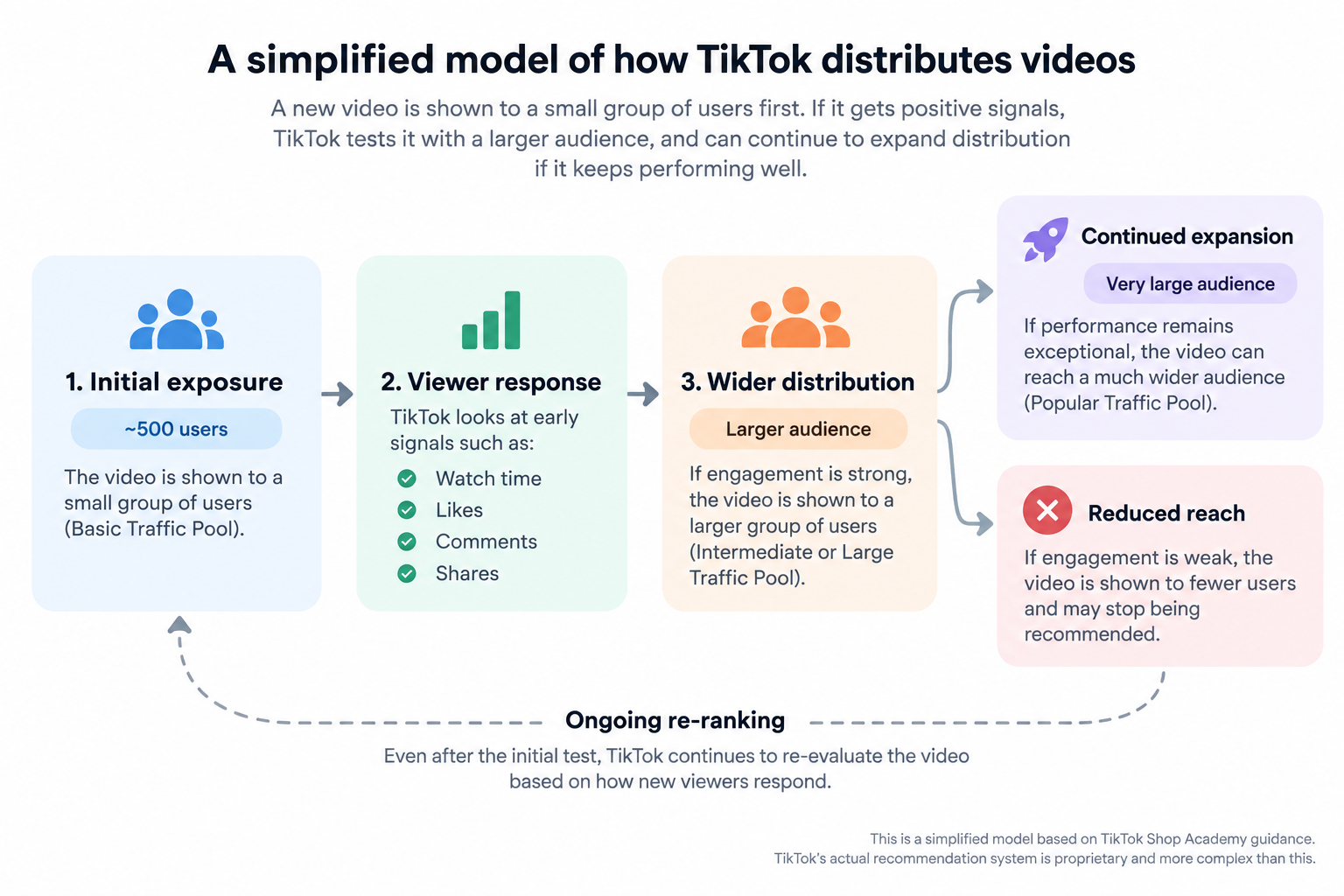
Since this description comes from the training for TikTok Shop, it shouldn’t be treated as a technical specification for their organic recommendation algorithm, but what we can take from this is that early audience response matters, and distribution can expand when content continues to interest viewers.
A video that starts slowly hasn’t necessarily reached its final audience yet. But in that same vein, getting good initial engagement doesn’t guarantee virality.
Why This Matters for Canvas UGC Accounts
Traditional influencer marketing often involves a brand paying for access to an audience that a creator has already built. Canvas UGC approaches distribution differently.
With Canvas UGC, creators are consistently publishing content through purpose-built accounts that are dedicated to a particular product. These accounts begin without an inherited audience and rely on organic discovery to reach viewers.
TikTok’s recommendation system is what made that approach possible, where an account's existing follower count isn’t the only factor determining who sees the video. And other short-form platforms have quickly followed suit.
Take a productivity app, for example.
You could hire a general lifestyle influencer with a large number of followers to then publish a sponsored video for you. That would give you access to an existing audience, but plenty of those followers might have no interest in a productivity tool.
Alternatively, you could hire a group of creators to create new accounts dedicated to your niche and post content regularly on those accounts.
The second approach gives you room to develop and test different content styles and formats and tie them to specific audience interests, without relying on an influencer’s follower base.
But there are always limitations, of course. And new accounts have no guarantee of initial distribution.
You’ll also see different results across accounts running similar concepts. Creators deliver messages differently; the same angle might land with some viewers and not others, and each video meets a different first audience. That’s normal. It’s also why judging Canvas UGC on one account’s first week tells you very little.
The most useful data is gained when you analyze patterns across many videos and several accounts, which is the case for testing at volume, which we cover in How to Test Canvas UGC.
And the opportunity comes from being able to develop and refine content at scale, without relying on someone’s existing following.
Which Metrics Matter for TikTok Distribution?
If you're trying to understand why one Canvas UGC video reached thousands of people while another went nowhere, start by looking at the engagement data.
Here’s what TikTok has confirmed. Viewer interactions matter most, including likes, shares, comments, follows, and whether someone watches in full or skips. You should also take into account the information contained within the video itself.
Watch Time and Completion Rates
TikTok explicitly mentions watching videos in full, skipping them, and the total time spent watching as relevant data points for recommendation.
These behaviours are effectively telling the platform something about how much interest a viewer has shown.
If someone immediately swipes away from a video, the content may not have felt relevant to that viewer.
On the other hand, if they continued watching a video until the end, that's a much stronger indication that the video held their attention.
Completion rate also adds context here, but you need to consider video length. Finishing a short clip requires a different level of commitment than watching a much longer tutorial.
But you shouldn’t fall into the trap of considering one single retention metric as a guaranteed route to distribution.
Engagement: Shares, Saves, Comments, Likes
Different engagement actions can tell you different things about the audience.
Data Point| What it can suggest | What it doesn’t tell you
Watch time | The video held attention | Whether the viewer cared about the product
Completion | Viewers stayed to the end, or the video was short | Whether the ending did any work
Fast skips | The opening didn’t feel relevant or interesting | Whether the idea itself was wrong
Rewatches | Something was worth seeing twice, or was hard to follow | Which of those two it was
Shares | Viewers thought it was relevant to someone else | Whether the sharer or recipient is a potential user
Saves | Viewers expect to come back to it | Whether they ever will
Comments | Questions, objections, discussion, or strong reactions | Sentiment, until you actually read them
Likes | A quick positive response | Much beyond that
TikTok hasn’t confirmed that one share always counts more than one like, or that a save has a higher numerical weighting than a comment, but when you consider what each action suggests, it makes sense that different factors influence the algorithm differently.
For app marketers, it’s also important to consider the context of each video. Be sure to continually ask: “What was the video trying to do?” when evaluating the different metrics.
Imagine a productivity app tutorial that gets a high save rate. That probably points to practical interest in the use case. Now imagine a comedy skit for the same app that gets heavy shares. That may bring in reach without much install intent, because people are sharing the joke rather than the product. Both are useful pieces of information, but they don’t necessarily tell you the same thing.
We go into a lot more detail on measuring UGC, covering what metrics to track based on your intended business outcomes in our guide: How to Measure Canvas UGC
Why the Opening Seconds Matter So Much
If one creative decision deserves the most attention when creating a video, it’s the hook.
The first few seconds of a video are where viewers decide whether to keep watching. And keeping viewers watching is what produces watch time and completion, which TikTok counts among the more important signals of interest.
If viewers swipe away before that window closes, the algorithm will read it as low-quality or irrelevant content and will limit distribution. It doesn’t matter how good your video gets at second 10 if nobody’s still there to see it. So you should treat the opening as where most videos are won or lost, but not the only thing that’s being judged.
Creator content typically opens the same way that native TikTok content opens:
- A creator talking right to the camera like they’re telling a friend something
- A creator’s reaction paired with a text hook makes you pause
- A skit that opens with a relatable scene before you even clock what’s being promoted
- A slideshow with a first frame designed to stop the scroll
All these formats match how people actually use TikTok, So viewers treat them as content worth watching. But when the opening immediately feels like an ad (Logo animation, slow product shot, very high-production, etc.) - viewers are likely to swipe away quickly.
Banner blindness is real, and users have learned to identify and skip anything that looks like an ad in a split second. UGC gets past that filter because it looks like everything else on the For You Page.
Does TikTok Actually Prefer Canvas UGC Over Brand Content
Not explicitly.
TikTok doesn’t label videos as UGC or branded, and there’s no documented ranking advantage for content because it comes from a creator account or a purpose-built account. The system responds to how viewers behave.
Creator-native content often wins on that behaviour. The pacing, the person on screen, and the format match everything else in the feed, so viewers give it more of a chance. Why UGC Works goes into the psychology behind that.
That advantage depends on execution, though. A sharp branded demo can easily outperform a weak creator video, and a polished video isn’t necessarily penalised for being polished. What gets penalised through viewer behaviour is content that people don’t want to watch.
Keep in mind that Canvas UGC is commercial in nature. But Canvas UGC videos can still feel native and perform well while being honest about that relationship.
TikTok Now Works Like a Search Engine
Beyond the FYP, TikTok has become a genuine search platform. Nearly 40% of Gen Z prefer searching on TikTok over Google, and Adobe found that 64% of Gen Z have used TikTok as a search engine at some point.
The algorithm scans several layers of your content for keywords:
Spoken audio carries a lot of weight. TikTok’s speech-to-text engine transcribes voiceovers, and what you say in the first few seconds matters more for ranking than written text.
On-screen text and captions get scanned through OCR. TikTok recommends 2-3 relevant hashtags per video and using native text tools for better indexing.
This gives Canvas UGC another edge. Creators naturally describe products the way people actually search for them. They say "this app is Duolingo for gym" instead of "our revolutionary app gamifies your fitness to keep you consistent." The first phrase matches how people search. The second doesn't.
Where This Leaves You
TikTok’s recommendation system gives purpose-built accounts a solid advantage. Follower count isn’t a direct ranking factor, and distribution expands when viewers respond. That opening comes with no guarantees. Some videos will reach a lot of people. Others won’t. And reach alone doesn’t put users in your app.
What the system rewards is content that people choose to keep watching.
For an app team, the practical job is to keep producing varied videos, analyze what viewers do with them, and feed that back into the next round of content.
Doing that well across several creators and accounts is a real operation, and it’s the part most teams underestimate.
FAQs
Can a new TikTok account go viral without followers?
It can. TikTok says follower count isn’t a direct factor in recommendations, so a new account’s videos can reach large audiences if viewers respond well. It isn’t guaranteed, and most early videos from new accounts won’t travel far.
Does TikTok prefer UGC over branded content?
Not as a category. TikTok doesn’t rank content higher for coming from creators or purpose-built accounts. Creator-native videos often earn better viewer responses, and that’s where the advantage comes from when there is one.
How long does TikTok take to distribute a video?
There’s no fixed timeline. Newly uploaded videos may not be eligible for recommendation until any review finishes, and some videos find their audience days after posting.
Does posting more frequently increase organic reach?
More posts create more opportunities for discovery and creative learning. TikTok doesn't publicly confirm that following a specific daily publishing quota guarantees more reach. Content relevance and audience response still matter.
How long does it take for a TikTok video to go viral?
TikTok tests videos with a small batch of viewers first, then scales distribution based on performance. Unlike Instagram, where reach usually peaks within 24 hours, TikTok videos can suddenly take off on day 3 to 5.
What is a good completion rate on TikTok?
There's no single benchmark, but higher completion rates consistently correlate with wider distribution. Videos that hold attention through the full runtime, or get rewatched, signal quality to the algorithm.
What does the TikTok algorithm measure to decide if my video gets pushed?
It measures watch time and completion rates, rewatches, and meaningful engagement. Essentially, the algorithm is designed to ask: “Is this content relevant?” and “Does it keep viewers engaged and on the platform”.



.webp)


