


If you want to run creator content at any real scale, at some point you’ll face the same decision every brand does: Should I build this capability myself, or should I work with a team that already knows how to run one?
For Canvas UGC, that decision goes beyond who films the videos. Creators publish content regularly through purpose-built accounts dedicated to your app. Someone has to recruit and brief them, keep those accounts running, organize publishing, test creative ideas, review performance, and decide what to try next.
You can own all of that internally, hand most of it to a specialist agency, or split the work.
In-house makes sense when you have the expertise and a good reason to build the capability. An agency can make sense when the operational burden is the main constraint. A hybrid approach works when you want to retain strategic control without managing every creator and account yourself.
The right choice depends on the capacity you already have, the scope you want to run, the total cost, and what you need to retain if the arrangement changes. If Canvas UGC is new to you, our guide to How Canvas UGC works explains it in more detail.
Canvas UGC In-House vs. Agency: The Key Differences
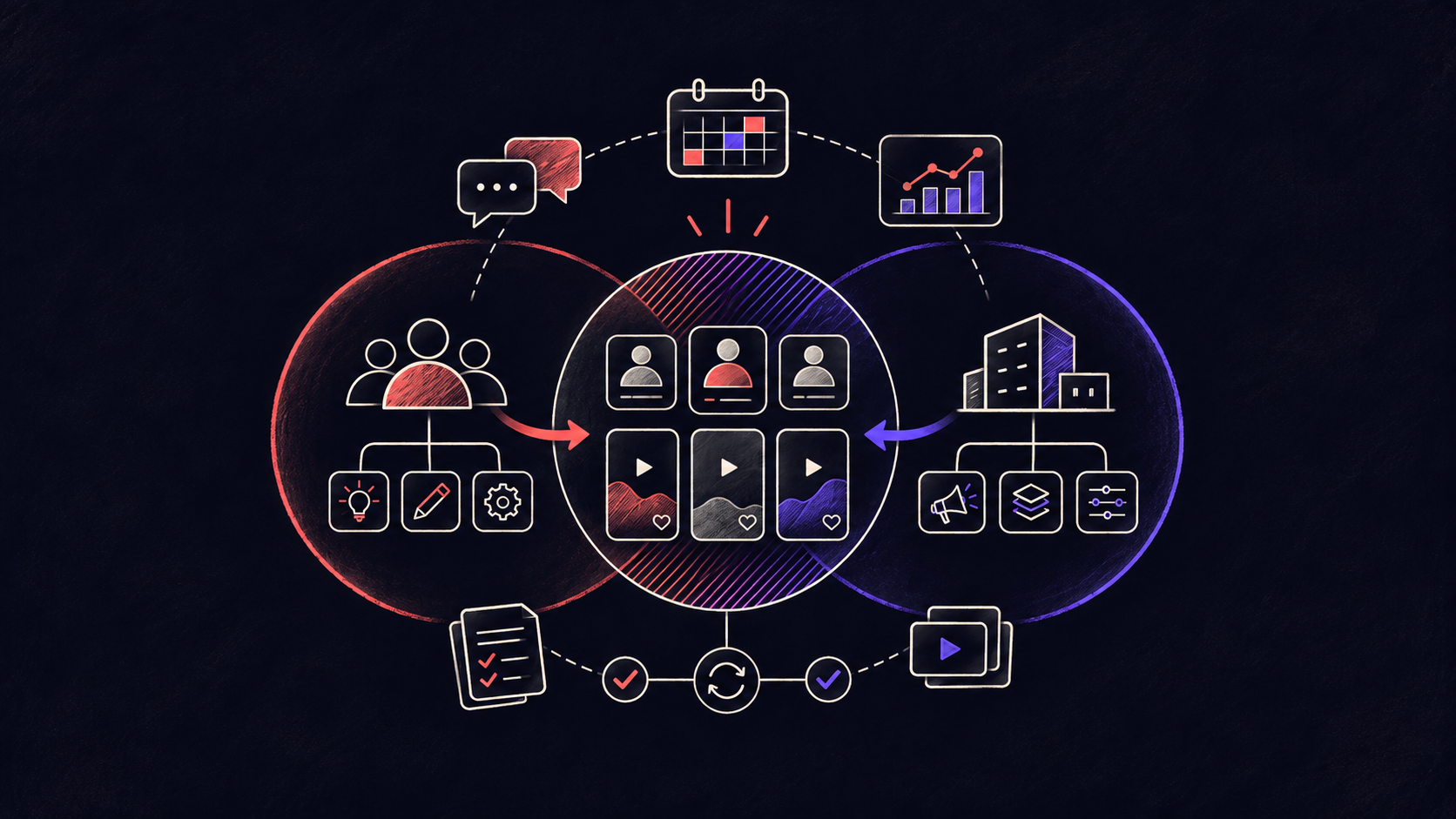
There’s work to be done regardless of the route you choose. What changes is who is responsible for it and how much direct control your team keeps.
What you're comparing | In-house | Specialist agency | What a hybrid approach may look like
Strategy and creative direction | Internal team sets and updates the plan | Partner develops the plan with client input | Client owns direction; partner helps refine it
Creator sourcing and management | Internal team recruits, briefs, manages, pays, and replaces creators | Delegated to partner if included in scope | Usually delegated, with client approval where needed
Dedicated account setup and publishing | Internal operations coordinate the accounts | Partner coordinates setup and publishing | Partner executes within agreed client rules
Testing and iteration | Internal team analyses results and briefs the next cycle | Partner manages the creative feedback loop | Shared decisions, partner-led execution
Reporting | Internal collection and analysis | Agreed reports and data access | Shared dashboards and review meetings
Staffing and management time | Direct operating capacity required | Internal owner still required | Internal strategist or program owner required
Cost structure | Labor, creator pay, tools, setup, and overhead | Agency fees and internal oversight time | Retained internal cost plus partner scope
Control and continuity | More direct control, subject to creator and platform terms | Depends heavily on contract and account setup | Negotiated by responsibility and asset
This comparison is about operating the ongoing organic program. If you only need finished videos to use in paid campaigns, you're making a different buying decision. Our Complete Guide to UGC Marketing for Apps covers those different models.
What Does Running Canvas UGC In-House Involve?
Running Canvas UGC in-house gives your team direct control over how the program develops. Your team works directly with creators and makes all the calls. Over time, a team may develop its own understanding of what performs, which can become a useful internal capability.
But there's quite a bit of work involved in getting to that point. Once creators are sourced and accounts are set up, someone needs to keep everything moving. This includes dealing with problems as they come up, and making sure that the content is actually improving. It's an ongoing commitment that extends beyond getting the first batch of videos live.
Recruiting creators is only the beginning
Finding creators who can make good content about your app is only the first challenge. Now you need to consistently get them to deliver content that feels relevant to your audience.
Even after you've found the right people, there's still plenty to manage. Creators need to be briefed about the product along with any guidelines they need to follow when creating content. Both the creator briefs and the content guidelines will evolve as you learn what works. Someone needs to handle contracts and payments. Someone needs to follow up with creators when deadlines slip. And someone will need to find replacements when things don't work out.
A creator marketplace or UGC creator sourcing platform can make the recruitment process easier or simplify some of the administrative work, but unless you're paying for ongoing management, the responsibility for keeping the program running still sits with your team. You can work entirely with freelance creators and still operate Canvas UGC in-house.
Dedicated accounts need constant attention
With Canvas UGC, each creator publishes content through an account that's dedicated to your app. Your team needs to think about how those accounts are positioned, who has access to them, and how publishing will continue if a creator leaves or becomes unavailable. There's also the less predictable side of account management, including restrictions and making sure content meets platform and disclosure requirements.
And once the content starts going live, you need to learn from it.
Imagine one creator posts a product demo that gets people asking questions about your app, while another gets significantly more views with a funny skit that barely mentions the product. Both might have value, but they're telling you different things.
Someone needs to recognise those differences and use them to decide what to test next. Otherwise, it's easy to keep producing content without getting much closer to understanding what actually works.
Who needs to work on it?
How many people you need depends on the scale of the program and the experience you already have internally.
For a smaller test, an experienced marketer or growth lead might be able to oversee the creative direction while coordinating a handful of creators. But as you bring on more creators and accounts, keeping everything organised and making sense of the results can become a substantial job in itself.
There's also the question of what your existing team would stop doing to make room for this work. If your Head of Growth is spending hours chasing missed posts or dealing with creator issues, that's time they aren't spending on other acquisition priorities. Even without hiring anyone new, that has a cost.
What Does a Specialist Canvas UGC Agency Handle?
Working with an experienced Canvas UGC agency can take much of that operational burden off your team. Instead of building your own recruitment processes, training people to manage creator accounts, and figuring out the workflows through trial and error, you're working with a team that already has experience running these programs.
An experienced operator often has:
- An established network of creators to recruit from
- Predefined workflows and best practices for setting up and managing accounts
- Creative testing systems designed to analyze and iterate on content to find the winning threads
- An experienced team with defined roles to manage the day-to-day work
With a fully managed Canvas UGC program, the agency takes responsibility for keeping the operation moving after creators have been recruited. That means making sure they understand your product, coordinating what gets published, and dealing with the inevitable problems when deadlines slip or a creator needs replacing. The agency should also be looking at how the content performs and using those insights to guide what gets made next.
Always check the actual scope. An agency advertising "UGC" may primarily sell individual creative assets. Another may manage creators but leave publishing or analysis to you. Neither automatically provides the entire Canvas operation.
Outsourcing also doesn't eliminate your team's involvement. Someone at the app still needs to supply access to your product, explain the target audience, approve relevant claims and restrictions (where applicable), and share available performance data to help inform future decisions. And ultimately, someone needs to decide whether continued spending makes commercial sense.
An agency can take responsibility for agreed execution; it can't make your product convert or guarantee organic distribution.
A useful way to evaluate an agency is to separate two kinds of accountability:
- Operational delivery: Were the agreed deliverables met? This can include creators, accounts, posts, creative variations, quality standards, and reporting.
- Commercial contribution: Is there credible evidence of relevant audience interest, useful creative learning, installs, or other business value relative to the program cost?
Both matter. A Canvas UGC program can meet its publishing targets and still fail to justify another month of investment. It can also show promising engagement while the app's conversion path limits the commercial benefit.
Agree on how those outcomes will be reviewed before work starts. Our Canvas UGC measurement guide explains how to separate delivery, content performance, learning, and business results.
Canvas UGC In-House vs. Agency Costs: What Are You Really Paying For?
Comparing an agency's monthly quote with the salary of one employee doesn’t tell you much. Similarly, evaluating costs purely on a cost-per-video basis gives you too limited a view.
An agency’s fees may include creator compensation, management, tools, and reporting. Some agencies may charge those costs separately. If you're looking to run the same operation yourself, keep in mind that salaries and creator compensation are only one part of that.
Start with a scope that both options would actually deliver: number of active creators, unique videos, publishing platforms, review requirements, replacement arrangements, reporting, and the length of the commitment. Don't compare a ten-creator agency plan with an internal budget for two creators and call the cheaper option more efficient.
What to include in your in-house budget
You should include the time your team spends on all aspects of a Canvas UGC campaign. These include:
- Recruitment & creator sourcing
- Creative strategy & briefing
- Account management
- Publishing oversight
- Quality control
- Performance analysis
- Internal team payments
- Overall administration
Add creator compensation, replacement costs, tools, training, and the time needed to establish your processes. How much these contribute to the total depends on the scale of the program and the resources you already have.
An existing team may genuinely have some spare capacity, which lowers the additional investment. But if those people could otherwise be working on paid acquisition, product marketing, or growth experiments, their time still has an opportunity cost.
What to check in an agency's quote
When evaluating a Canvas UGC agency, ask whether their quote includes creator pay, account setup, platform coverage, creative variations, reporting, replacement creators, usage rights, and any performance-related compensation. Also account for the internal oversight time and any separately billed tools or services, too. Some agencies bundle creator compensation, management, publishing, and reporting into one fee, while others charge for certain services separately. Before comparing proposals, make sure you understand what's included, what could cost extra, and what your internal team will still need to handle.
The cost of the learning curve
There is another cost to building in-house that you wouldn’t see in a salary comparison: learning how to operate the program well.
Your team needs to develop judgement about which creators can explain the app, how to brief them without scripting away their personality, how to organize purpose-built accounts, and which hooks or formats are worth testing next. You also need processes for creator dropouts, content quality, disclosures, reporting, and interpreting patchy organic data.
Some trial and error is unavoidable whichever route you choose. But a team starting from scratch can spend its early cycles learning basic operational lessons that a specialist already has defined protocols for. A creator might be unsuitable, account access might be poorly documented, or a month of posting might reveal little because the briefs never tested distinct ideas. The real cost should include the money spent on that work, the time people spend fixing it, and the creative learning or market feedback you could have gathered instead.
This is one reason to consider an experienced agency. You're paying for an existing team and processes that may help you avoid some of the trial and error involved in building the operation yourself. But that experience needs to be relevant to your app. Another company's winning creative approach doesn't necessarily translate to your audience.
An agency also needs time to understand your product, users, and commercial goals. Make sure that the insights and performance data from the program are shared with your team. Otherwise, you might save time building the operation but become dependent on the agency to understand what's working.
If bringing the program in-house is a long-term possibility for your team, ask the agency what documentation, performance data, creator arrangements, and account access would be available if you eventually made that transition.
Different Providers Offer Different Levels of Support
Two agencies can both describe their service as "Managed Canvas UGC" and offer very different programs.
- One might handle everything from creator recruitment to publishing and ongoing optimization
- Another might source and brief creators but leave account management, analysis, or other day-to-day work with your team
That difference affects the price and the overall value you're receiving, as well as the internal workload involved on your end.
Before comparing proposals, check what the provider is actually taking responsibility for:
Creators and compensation | Does the fee cover finding, vetting, onboarding, paying, and replacing creators? Are creator fees or performance bonuses billed separately?
Accounts and publishing | Does the provider set up and manage purpose-built accounts, coordinate recurring posts, and cover the platforms you need? Or will your team need to handle some of that work?
Content output | How many active creators and genuinely new videos are included? Are cross-posts or edits counted separately from original creative?
Creative strategy and testing | Will the provider develop concepts, brief variations, review performance, and change the next round of content based on what it learns? Or does the service mainly deliver a fixed output?
Reporting and data access | What will you see at creator, account, and post level? Who interprets the results, and what performance information will your team need to supply?
Rights, approvals, and extras | What can you reuse in paid campaigns, what does your team still need to approve, and which setup, licensing, or additional-management costs sit outside the fee?
A narrower service may be perfectly reasonable if you already have people who can cover the gaps.
A broader managed program may be worth the additional investment if it takes significant operational work off your team's hands. Whether that makes financial sense depends on the agency's pricing, the scope of work, and the internal resources you would otherwise need.
Finally, try to compare the value against the cost. Did the program publish what was agreed, test enough genuinely different ideas to learn from, and generate relevant audience or acquisition signals? Neither the lowest monthly fee nor the lowest cost per video can settle whether a program deserves further investment. For pilot planning, see How to Test Canvas UGC for Your App.
Control, Account Ownership, and What Happens If You Leave an Agency
In-house teams usually have more direct oversight of the work. But direct oversight, account ownership, and rights to the content are different things. They should be treated separately regardless of the operating model you choose.
A purpose-built account might be owned or controlled by the brand, a creator, or the agency, depending on the setup and agreement. In a managed campaign, don't assume that an account dedicated to your app automatically belongs to your business.
You should clarify who has administrative access, how account recovery works, and what happens if a creator stops working on the campaign. Also check the platform's applicable terms before assuming an account can simply be transferred to another party.
The rights to the videos are a separate issue. Receiving files doesn't automatically give you unlimited permission to edit, repost, license, or run the content as paid advertising. Contracts should spell out permitted channels, duration, modifications, raw footage, and any authorizations required for ad amplification.
If you're evaluating a partner, ask for clear answers to these questions before signing:
- Who controls each purpose-built account, its recovery details, and publishing access?
- Can the program keep running when a creator leaves, and who handles the handover?
- What can the brand do with published posts, raw footage, and edited videos during and after the contract?
- Can the brand access post-level analytics, briefs, test histories, and performance records?
- Can the brand keep working with individual creators if the agency relationship ends?
- What happens to live posts, account access, outstanding creator payments, and reporting at termination?
Good exit terms protect both sides. They also make a hybrid arrangement more practical if your intention is to build more internal capability later.
The operating agreement should also define how commercial disclosures are handled.
Paid creators need to be transparent about their relationship with the app. On TikTok, promotional content must be appropriately disclosed, while applicable regulations, including US FTC and UK CMA advertising guidance, may impose additional requirements. A purpose-built account can feel native to the platform without pretending its creator is an independent customer.
When Should You Build In-House, Hire an Agency, or Use a Hybrid Model?
The best option changes with your experience, the work you need done, and the importance of owning that capability. An agency can make sense for a team that wants to move quickly; an established internal operation may be able to move even faster once it is running. Here are the situations that should carry the most weight.
When a specialist Canvas UGC agency makes sense
You need to start publishing without building the whole operation first
A product launch, entering a new market, or an upcoming growth initiative may leave little room for recruiting an internal operator, building creator workflows, and establishing reporting from scratch. An experienced agency may already have much of that infrastructure. Ask how long the actual work for your app will take, including finding suitable creators, account preparation, product onboarding, and approvals. Faster setup is a possible advantage; faster installs or revenue are not guaranteed.
Your existing team understands growth, but lacks bandwidth for creator operations
A paid acquisition team may know its audience, conversion data, and creative priorities while having little capacity to recruit, brief, coordinate, pay, and replace creators. Bringing in a specialist lets that team remain focused on the areas where it already contributes value. It still needs someone internally who owns the brief, provides product access, and judges commercial results.
You want to reduce the cost of learning from scratch
An agency with relevant experience may know how to structure creator onboarding, account operations, content variation, and performance reviews before your team has developed those habits. This can reduce avoidable operational trial and error. It cannot remove the need to discover which angles genuinely resonate with your particular audience. Ask what the agency has learned from comparable products, how it makes creative decisions, and whether your team will be able to access the resulting playbooks and data.
You need a wider or more specialized creator pool
Recruiting creators who can credibly discuss a technical app, work in a particular language, or represent several audience segments can be slow. A specialist with suitable sourcing processes may help. The advantage depends on the people it can actually recruit, not the size of a claimed network. Ask for evidence of relevant creator fit and a credible replacement process.
Your content requirements change faster than you want to hire
An app studio might be launching several products, a team might test another market, or a business might need temporary additional account capacity. Outsourcing some execution may be more practical than staffing permanently for a peak that could disappear. Check minimum commitments and how easily the scope can change; an agency contract is not automatically flexible.
You want to validate an operating model before committing to permanent headcount
A scoped engagement can help establish whether recurring Canvas UGC produces enough useful learning or commercial value to justify continuing. That only works when the test has a clear question, sufficient creative variation, appropriate measurement, and a budget the company can justify even if the test is inconclusive. Buying an agency pilot does not make the channel risk-free.
An agency becomes a weaker choice when its processes are unclear, its category experience is unconvincing, or its reporting leaves the client unable to understand what is changing. It is also a poor substitute for product readiness, a clear owner, or an adequate budget.
When running Canvas UGC in-house makes sense
You already have the expertise and creator infrastructure
If your team recruits and manages reliable creators, understands organic short-form creative, and has workable account and reporting processes, an external partner may add another layer rather than solve a problem. Existing internal capability can also make your time to execution shorter than an agency's onboarding process.
You have predictable, sustained demand for the work
Recurring activity can justify dedicated internal staff when the workload is consistent enough to use them well. This is particularly relevant for an established app or portfolio that expects creator-led organic content to remain a central part of acquisition. Fixed staffing can become more economical over time, but only if the output, hiring costs, oversight, and ongoing performance make that true for your business.
You want the expertise and relationships to become part of the company
Direct access to creators, decisions about account development, creative-testing records, and accumulated understanding of your audience can be strategic assets. For businesses treating creator-led organic distribution as a long-term capability, there is a legitimate reason to keep those relationships and much of that knowledge inside the organization.
The work needs very close product or compliance involvement
Some apps change quickly, need careful demonstrations, or operate in categories where every product claim needs specialist review. An internal operation may be easier to coordinate with product, legal, and growth teams. A properly governed agency or hybrid can still work, but it must meet the same approval and disclosure requirements.
You need to change creative direction continuously
When analysts, product marketers, and creators already work closely together, an internal team can adjust briefs and priorities without an external handoff. That speed advantage is easy to overlook when comparisons only discuss how quickly an agency can launch from zero.
Direct control is more important than convenience
If the company wants to make every creator decision, retain account access, and govern the entire operation itself, internal ownership may be worth the extra management time. You still need to establish rights and account-access arrangements with individual creators; being in-house doesn't automatically settle those questions.
The main drawback is that you carry the work through weak creative cycles, hiring mistakes, creator turnover, and quieter periods. An internal team can be excellent, but it doesn't become excellent merely by being on payroll.
When a hybrid arrangement makes sense
A hybrid approach becomes useful when the company has strong strategic judgement but not enough operational capacity. For example, a Head of Growth might retain product positioning, the testing priorities, performance interpretation, and the decision to continue, while a specialist handles sourcing, creator communication, account coordination, and publishing.
It also makes sense when only one part of the program is difficult to staff. A company with a good internal creative lead may need help recruiting creators in a new market. Another may handle creators directly but need temporary support for publishing coordination or reporting. The partner's scope can be narrower than the entire operation.
For an app portfolio, a hybrid can help internal growth teams retain product knowledge while drawing on outside execution capacity as launches and market priorities change. And if long-term in-house ownership is the goal, a partner can operate the program initially while the client documents the process, hires carefully, and moves selected responsibilities inside over time.
The risk is unclear ownership. A hybrid only works when the parties agree on who approves creative, who briefs creators, who monitors accounts, who responds when posting breaks down, who can access analytics, and who holds the accounts and content rights. A shared reporting and learning process matters as much as the division of tasks.
When none of the three is the right move yet
If the product cannot deliver the experience creators would promote, if nobody owns the decision internally, or if the business depends on immediate acquisition results to fund another cycle, consider delaying or reducing the scope.
A Practical Decision Framework for Your App
Evaluate the decision by looking at the team and business you have today, rather than the operation you hope to have eventually.
Your situation | Direction to consider | The deciding question
You need to launch soon but have no existing creator operation | Agency | Can a specialist get the program running sooner than you could internally?
Your growth team lacks the expertise or capacity to manage creators | Agency or hybrid | Which responsibilities do you actually need to delegate?
You already have experienced creator operators and consistent demand | In-house | What additional value would an agency provide?
You need creators across multiple audiences, languages, or markets | Agency or hybrid | Does the partner have relevant sourcing expertise?
You want to test Canvas UGC before making permanent hires | Scoped agency engagement or limited internal test | Can you afford a meaningful test with uncertain results?
You have strong internal strategy but limited execution capacity | Hybrid | Which operational tasks can you delegate?
Your product needs frequent changes or close compliance oversight | In-house or specialist hybrid | How closely must your team oversee creative?
You want to own creator relationships and build lasting expertise | In-house or hybrid | Is developing that capability worth the ongoing investment?
Your content requirements fluctuate across launches or products | Agency or hybrid | Can the arrangement accommodate changing workloads?
You eventually want to bring the operation in-house | Transition-focused hybrid | Can you retain the knowledge, access, and processes needed for handover?
Your product, budget, or measurement setup isn't ready | Reconsider timing or scope | What needs to change before the investment makes sense?
What you start with doesn’t necessarily determine what you do next. A business may start with an agency to learn what is involved and later hire an internal team. Another may keep an agency because the workload would distract its growth team from more valuable work. Both can be sensible decisions.
Before making your decision, agree on what you want to learn or achieve, who is responsible for each part of the operation, how much you can spend, and what evidence would justify the next cycle. If you don't have a useful next step for interested viewers, or can't afford to test without immediate returns, address those constraints before committing to a larger program.
What to Ask Before Hiring a Canvas UGC Agency
If you decide to partner, don't stop at asking how many videos you'll receive. Ask what happens around each video and account before and after publication.
Scope and delivery
- Do you run dedicated creator accounts that publish organically, or primarily supply finished UGC files?
- Which parts of sourcing, briefing, account setup, publishing, quality control, and creator replacement do you manage?
- How many unique videos and active creators are included, across which platforms? What happens if output falls short?
Cost and working relationship
- What's included in the fee, and what is billed separately? Are creator payments, setup, performance bonuses, and usage rights included?
- What will our team need to provide and approve? Who has final responsibility when a brief, creator, or account needs to change?
Measurement and commercial accountability
- What can we see at post and account level? How do you record creative tests and decide what to change?
- How will we evaluate delivery, relevant audience response, creative learning, and business impact? Which outcomes can you measure reliably, and which remain uncertain?
Ownership, safety, and exit terms
- Who controls the accounts, creator relationships, raw files, content rights, and analytics during the engagement and after it ends?
- How are advertising disclosures, product claims, and market-specific restrictions handled?
- What are the notice terms, handover responsibilities, and costs if we stop or bring the operation in-house?
A good proposal should make the responsibilities and limitations easy to understand. Relevant experience and case studies matter, but an impressive view count doesn't replace clarity on what your app will actually receive or how you'll judge the investment.
FAQs
Is it cheaper to run Canvas UGC in-house or hire an agency?
There's no universally cheaper option. The total cost depends on the scale of your program, the resources you already have, and what's included in an agency's fee.
Running Canvas UGC in-house can become more cost-efficient if you have the expertise and enough recurring work to justify dedicated staff. But you'll also need to account for creator payments, management time, tools, and the cost of building and maintaining the operation.
An agency may cover work you'd otherwise need to hire for or allocate to existing employees. Whether that represents better value depends on the scope, the agency's fees, and how much operational responsibility it actually takes on.
Can you run Canvas UGC in-house without hiring a dedicated team?
Yes. If you already have someone with the right experience and enough time to manage the work, you can start with a relatively small operation using freelance creators. You don't necessarily need a separate employee for every function. The challenge comes when you increase the number of creators and accounts, and the level of deliberate variation in the content, because managing production while keeping up with creative testing can become difficult alongside other marketing responsibilities.
Is hiring a Canvas UGC agency faster than building in-house?
It can be, especially if you're starting without an existing creator operation. An experienced agency may already have recruitment processes, account management systems, and people who know how to run these programs. That can reduce the time spent building everything from scratch. However, the agency will still need to understand your product, recruit suitable creators, and prepare accounts before publishing. Faster setup also doesn't guarantee faster commercial results.
How much involvement does a fully managed Canvas UGC agency require from our team?
A fully managed agency can handle most of the day-to-day creator operation, but your team still has an important role. You'll need someone who understands the product, can provide feedback, and can make decisions about the campaign's objectives and performance. You shouldn't need to chase individual creators or coordinate every post, but you'll still need to stay involved in the decisions that affect your business.
Are creator payments included in Canvas UGC agency fees?
That depends on the provider. Some agencies include creator compensation in their management fee, while others charge separately for creators, performance bonuses, or additional services. Before comparing proposals, check exactly what's included and what could increase the total cost. You should also understand whether the fee covers ongoing creator replacements and management, rather than just finding creators at the beginning.
Who owns the Canvas UGC accounts and content when working with an agency?
It depends on how the program is set up and what you've agreed with the provider. Purpose-built accounts may be controlled by the agency, the client, or individual creators. Rights to the videos are a separate consideration, particularly if you want to reuse them in paid advertising. Make sure the agreement explains account access, permitted content usage, and what happens to both if the partnership ends. Account transfers may also be subject to platform rules.
Can you start with a Canvas UGC agency and eventually bring the operation in-house?
Yes, and that can be a sensible approach if you want to build internal expertise without taking on the entire operation immediately. Working with a specialist can help you understand the workflows and creative-testing processes before committing to permanent hires. However, bringing the program in-house won't necessarily be seamless. You'll need to plan for creator relationships, account access, documentation, and the transfer of responsibilities. Discuss those arrangements before entering the partnership.
Does working with a Canvas UGC agency guarantee better results?
No. An experienced agency may help you avoid common operational mistakes and bring useful expertise from other campaigns, but it can't guarantee views, installs, or a particular return on investment. Results still depend on your product, the audience you're trying to reach, the creative approaches being tested, and what happens after someone discovers your app. The important thing is agreeing on what success means and evaluating whether the program is delivering enough value to justify continued investment.